Case Study
Bamboo Bilpin Cabin
.jpeg?width=1920&quality=80&format=auto)
Project Type
Applications
Products
Location
Photography
Architect and Desginer
This cabin is a small building with a long shadow. It changes what engineered bamboo is allowed to be. This cabin is the one that moves engineered bamboo from a beautiful exception to a material you can specify, and the EPDs mean more projects like it are now possible.
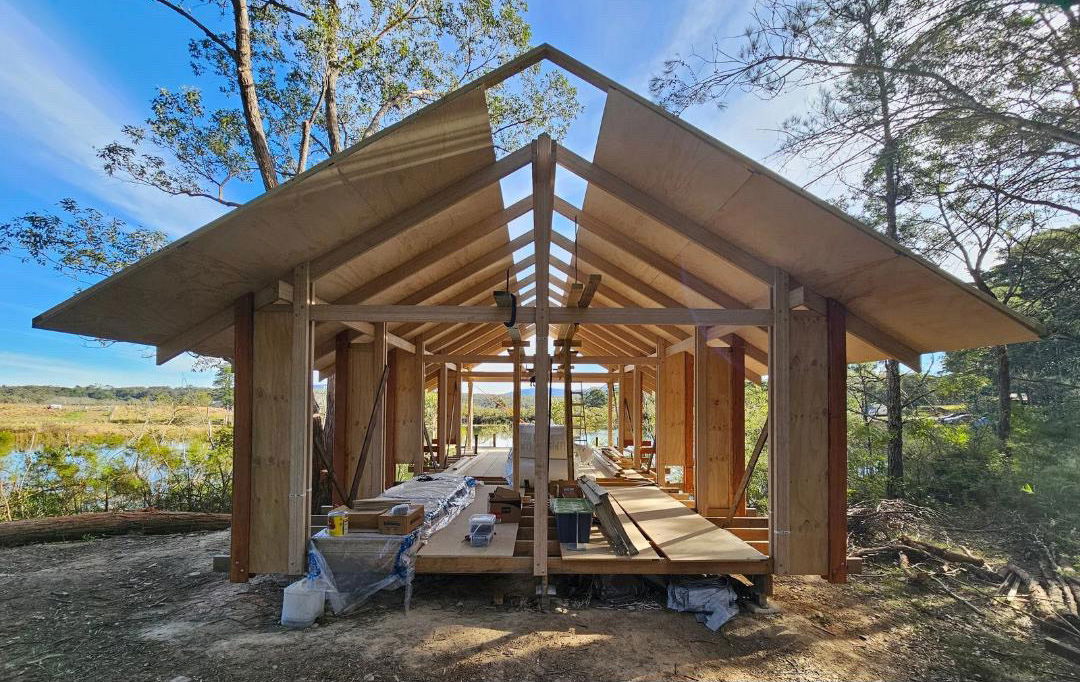
For years, Jed Long's woven bamboo towers and tunnels made people fall in love with the material as an idea. The cabin is where that vision grows up. On a remote, sloping site at the edge of a wetland, House of Bamboo helped him put up something Australia has rarely seen: a home with a full engineered laminated bamboo frame as its primary structure, certified and signed off the same way any other house would be. The bamboo isn't cladding or a feature wall. It's the structure, left exposed so the frame, the joints and the load path are there to read.
Getting there meant proving the material the long way, because Australia has no standard design table for structural bamboo. Working alongside a structural engineer and a certifier, the team modelled the frame, ran the calculations and earned the sign-off, page by page. Every one of those pages now exists as reference for the next build. And with verified Environmental Product Declarations now behind the laminated and structural glued bamboo, the environmental case arrives documented rather than argued from scratch. Jed Long's cabin stands as one building. What it leaves behind is a pathway.
The architect's goal
Long has spent years researching how traditional bamboo construction translates into contemporary building practice, work supported by a Churchill Fellowship and an ongoing PhD at the University of Tasmania. The installations answered an artistic question. The cabin answers a regulatory one: how to build a permanent, approvable home in Australia using bamboo as the structure component.
That question sets the brief in a new direction for engineered bamboo and one that’s becoming more common. In the Australian market, bamboo most often appears as cladding, screening, decking or ceiling lining. Beautiful, durable, well understood. The cabin asked bamboo to do the structural job that timber, steel and concrete normally hold, and to do it inside the National Construction Code rather than around it.
Long's stated aim was to deliver what he describes as the next step to certify buildings made from engineered laminate bamboo, conceived as a repeatable housing module. The cabin is the pilot that tests whether that ambition holds up against a building approval.
.jpeg?width=1920&quality=80&format=auto)
-1.jpeg?width=1920&quality=80&format=auto)
Why bamboo works structurally
Bamboo's structural case is straightforward once you separate the raw culm from the engineered product.
Raw bamboo is round, tapered and variable, which is exactly what makes Cave Urban's woven work so expressive and exactly what makes a building surveyor nervous. Engineered laminated bamboo solves that. The fibres are cut, treated, graded and glue-laminated into straight, dimensionally consistent slices, the same logic that turned variable hardwood into reliable glulam and CLT. The result is a section with predictable strength, a clean rectangular profile and a strong strength-to-weight ratio.
Two properties matter most for this build:
- Strength relative to weight. Laminated bamboo carries serious load while staying lighter than equivalent steel or hardwood members. On a remote, sloping, wetland-edge site, lighter structures mean easier handling and a lighter footprint on the ground.
- Consistency. Lamination removes the natural variation that complicates engineering certification. A graded, manufactured post can be specified, calculated and signed off the way an engineer expects.
With verified EPDs now in place for both the laminated and structural glued bamboo, a build like this can do more than stand up. The environmental performance is measured and documented, which means the material can be carried into projects chasing Green Star and similar ratings, written into specifications that demand life-cycle data, and put forward on jobs where bamboo would once have been ruled out for lack of proof. It moves engineered bamboo from an expressive material into one that competes for serious structural work on the same terms as steel and mass timber.
.jpeg?width=1920&quality=80&format=auto)
The solution: products and how they were used
The structural frame. A full engineered laminated bamboo frame forms the primary structure: posts, beams and the raked portal lengths that shape the gabled roof. The frame is left exposed rather than hidden behind plasterboard, so the structure is also the architecture. You can read the joints, the grain and the load path straight off the building.
Bamboo ply ceiling and linings. The raked ceiling and internal wall linings use bamboo ply, the warm textured surface that gives the interior its glow at sunrise and sunset. It earns its place beyond looks. Using one material family for both structure and lining cuts the number of trades and products on site and keeps the build legible.
Concealed connections run through the frame so the timber-and-bamboo language stays clean and the precision of the engineered members does the talking. And because the components are manufactured to consistent dimensions, the frame suited prefabrication: a faster, lower-waste assembly on a site where both genuinely count.
.jpeg?width=1920&quality=80&format=auto)
Nagivating Planning
The hardest part of this project was never going to be the carpentry. It was the paperwork.
Each bamboo structure in Australia currently has to be assessed on its own, because there is no standard design table for engineered bamboo the way there is for an MGP10 pine stud or a steel grade. That means working directly with a structural engineer to model the frame, generating the calculations a certifier needs, and walking a building surveyor through a material they have rarely, if ever, signed off as structure.
Getting the cabin approved is the real deliverable. Every page of engineering produced for it becomes reference material for the next project, and the one after that. This is how a material moves from experimental to specifiable: one certified building at a time, until the pathway is worn in.
This is also where the EPDs change the equation. With verified Environmental Product Declarations now sitting behind the laminated and structural glued bamboo, the environmental data no longer has to be argued from first principles either. The structural case is built one certificate at a time, and the sustainability case now arrives already documented.
"For years the question wasn't whether bamboo could perform, it was whether anyone would sign off on it. This cabin answers that. We now have a certified structure and verified EPDs behind the material, which means the next architect who wants to build in engineered bamboo isn't starting from zero. That's what moves it from a beautiful idea into something you can actually specify."
What the project demonstrates
The cabin proves three things at once.
It proves the engineering case, that laminated bamboo can be specified as primary structure and stand up to Australian load and climate demands. It proves the regulatory case, that a bamboo building can clear the same approval hurdles as any other home. And it proves the design case, that a structural bamboo building can be genuinely beautiful, not a worthy compromise.
For Jed Long, it also closes a loop. The woven towers and tunnels made the public fall in love with bamboo as an idea. The cabin makes the case that you can live inside one, with a certificate to prove it.
Explore more projects